


Excavators rely heavily on hydraulic systems to convert mechanical power into hydraulic force. Hydraulic cylinders are among the most important components in this system, controlling the boom, arm, bucket, blade, and other working attachments.
Because hydraulic cylinders operate under high pressure and perform continuous reciprocating movement, reliable sealing is essential.
A properly selected excavator hydraulic cylinder seal kit can help prevent oil leakage, reduce internal bypass, protect the piston rod and cylinder barrel, and extend the service life of the entire cylinder.
This guide explains the main types of excavator cylinder seals, their functions, common failure symptoms, and what to check when selecting or replacing a seal kit.
1.Why Are Excavator Cylinder Seal kit Important?
Excavator hydraulic cylinders operate under demanding conditions, including:
- Continuous reciprocating movement
- High hydraulic pressure
- High oil temperature
- Dust, mud, water, and debris
- Side loads and impact loads
The cylinder sealing system must perform two main tasks:
- Prevent hydraulic oil from leaking outside the cylinder
- Prevent internal leakage between the two sides of the piston
Cylinder seal failures are therefore generally divided into external leakage and internal leakage.
1.1 External Leakage
External leakage normally occurs around the piston rod and cylinder head.
If the rod sealing system fails, hydraulic oil may leak directly along the piston rod and out of the cylinder.
Typical symptoms include:
- Oil film on the piston rod
- Oil around the cylinder head
- Visible dripping during operation
- Increased hydraulic oil consumption
1.2 Internal Leakage
Internal leakage normally occurs between the piston and the cylinder barrel.
In this case, hydraulic oil bypasses the piston from the high-pressure side to the low-pressure side.
There may be no visible oil leak outside the cylinder.
Typical symptoms include:
- Boom drift
- Arm or bucket dropping
- Poor load-holding ability
- Weak cylinder force
- Slow cylinder movement
For this reason, a complete cylinder seal kit normally contains much more than just one main oil seal.
2.Rod-Side Cylinder Seals
The seals installed in the cylinder head are often referred to as the rod sealing system.
These components help prevent external oil leakage and protect the cylinder from contamination.
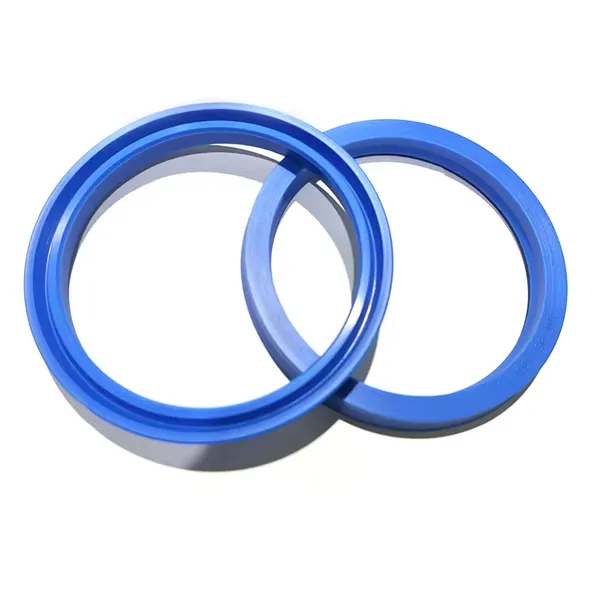
2.1 Rod Seal
The rod seal is one of the most important seals in the cylinder head.
Its primary function is to:
Prevent pressurized hydraulic oil from leaking along the piston rod and out of the cylinder.
The rod seal must maintain effective sealing while the piston rod moves repeatedly under high pressure.
How to Select the Correct Rod Seal?A harder or stronger seal is not always better.
The correct choice depends on:
- Cylinder condition
- Operating pressure
- Rod surface condition
- Groove design
- Seal material
- Equipment age
For an older cylinder with some wear, a reinforced rod seal or double-lip design may sometimes provide better sealing performance.
However, on a new or recently rebuilt cylinder, using an excessively hard or tight seal may increase friction.
This may result in:
- Higher operating temperature
- Increased friction
- Premature seal wear
- Slow or unstable cylinder movement
The correct size, material, and profile are more important than simply choosing the hardest seal available.
2.2 Buffer Seal
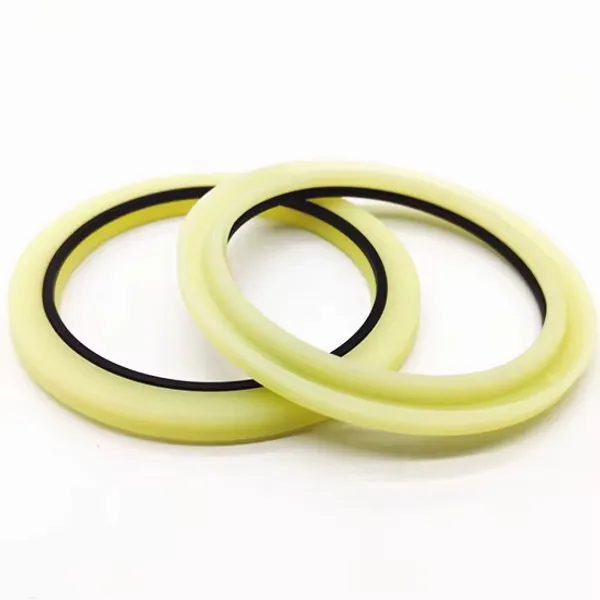
The buffer seal is normally installed behind the primary rod seal, closer to the pressure side of the cylinder.
Its main purpose is not simply to prevent leakage.
Its most important role is to:
Reduce pressure spikes before they reach the primary rod seal.
Excavator cylinders can experience sudden pressure peaks during heavy digging, lifting, impact loading, or rapid directional changes.
Without a properly functioning buffer seal, these pressure spikes are transferred directly to the rod seal.
This can greatly shorten rod seal life.
Main Functions of a Buffer Seal
A buffer seal can help:
- Absorb pressure spikes
- Protect the primary rod seal
- Improve high-pressure performance
- Extend seal service life
- Reduce seal extrusion under shock loading
Installation direction is extremely important. An incorrectly installed buffer seal may fail quickly even if the seal itself is high quality.
2.3 Dust Seal/Wiper Seal
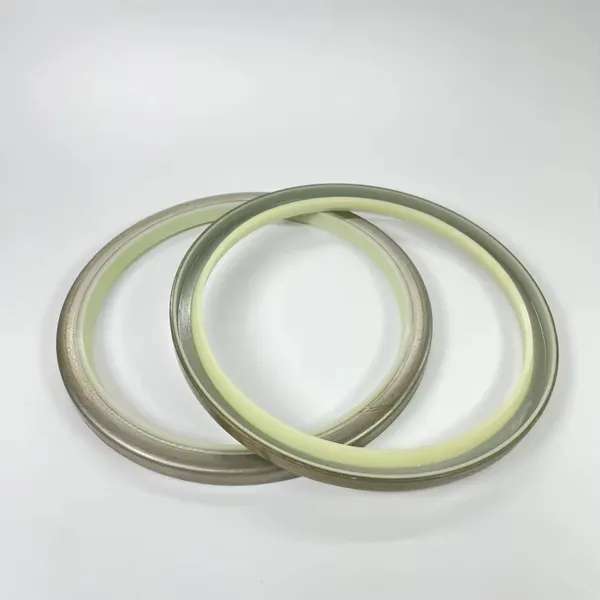
The dust seal, also called a wiper seal, is installed at the outermost part of the cylinder head.
Its purpose is to prevent external contaminants from entering the cylinder.
These contaminants may include:
- Dust
- Sand
- Mud
- Water
- Metal particles
- Other abrasive debris
Excavators often work in harsh construction, mining, demolition, and earthmoving environments, so the wiper seal plays a critical role.
If the wiper seal fails, contamination can enter the cylinder and damage:
Piston rod → Guide bushing → Rod seal → Cylinder barrel → Hydraulic system
Wiper Seal Selection Tips
The outer wiping lip should not be excessively soft.
A seal that is too soft may not effectively remove dirt from the piston rod.
It is also important to match the wiper seal to the correct groove dimensions rather than choosing one based only on outside diameter.
2.4 Guide Bushing
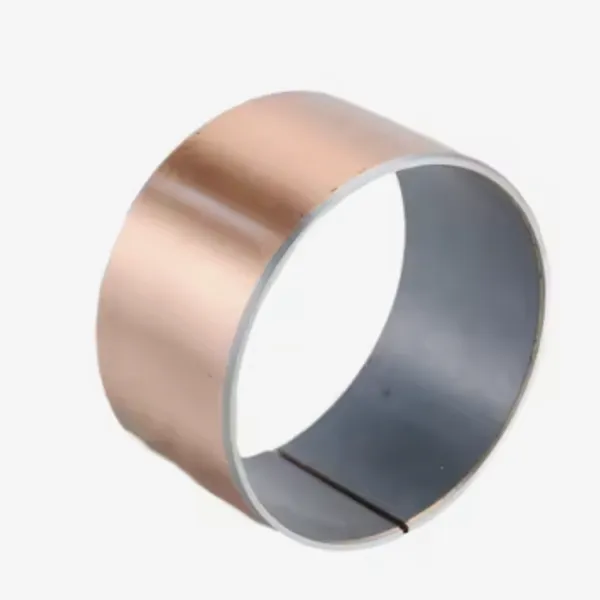
The guide bushing is often overlooked because it is relatively inexpensive but can be difficult to remove and replace.
However, it is a critical cylinder component.
Its main functions include:
- Supporting the piston rod
- Maintaining rod alignment
- Carrying side loads
- Preventing metal-to-metal contact
- Reducing uneven seal wear
If the guide bushing becomes badly worn, replacing only the rod seal may not solve the leakage problem.
When Should the Guide Bushing Be Replaced?
Replace or inspect it carefully if you find:
- Worn internal coating
- Deep scoring
- Excessive clearance
- Loose piston rod movement
- Uneven rod seal wear
A worn bushing can cause the rod to move off-center and quickly damage a new seal.
3.Internal Cylinder Seals
Internal cylinder seals are mainly installed around the piston.
Their main purpose is to prevent pressurized hydraulic oil from bypassing the piston.
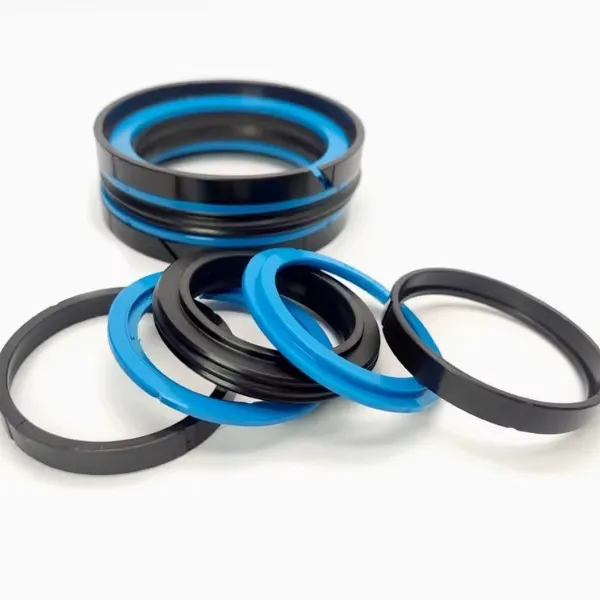
3.1 Piston Seal
The piston seal is the main sealing component responsible for preventing internal leakage.
Common designs include:
- Two-piece seal assemblies
- Four-piece seal assemblies
- Multi-piece composite piston seals
Some piston seals may look almost identical and may even have similar dimensions.
However, differences may exist in:
- Groove dimensions
- Seal profile
- Material
- Pressure capability
- Wear characteristics
For this reason, seals should not be substituted simply because they look similar.
Unless it is an emergency repair, always select a piston seal designed for the original cylinder groove.
3.2 Guide Rings and Wear Rings
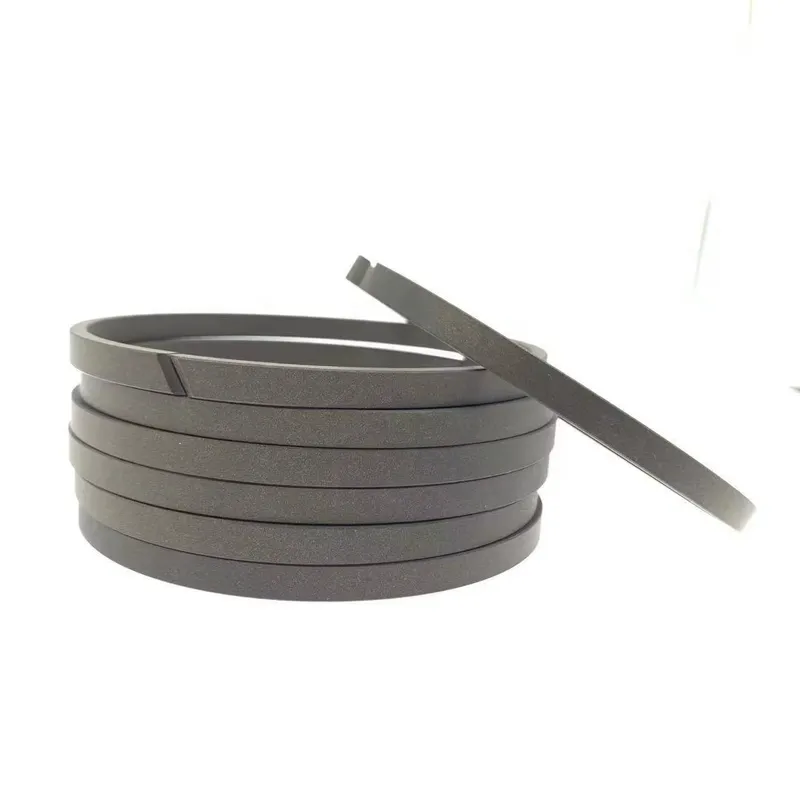
Guide rings and wear rings are typically installed around the piston or cylinder head.
Their main functions include:
- Supporting the piston
- Keeping the piston centered
- Carrying side loads
- Preventing metal-to-metal contact
- Reducing seal wear
- Stabilizing cylinder movement
Although these components do not perform the main hydraulic sealing function, worn guide rings can cause serious secondary damage.
Possible results include:
- Piston seal damage
- Uneven seal wear
- Cylinder barrel scoring
- Piston contact with the barrel
For this reason, guide rings should not be replaced with unsuitable low-cost materials simply to reduce repair cost.
3.3 Wear Ring Thickness Matters
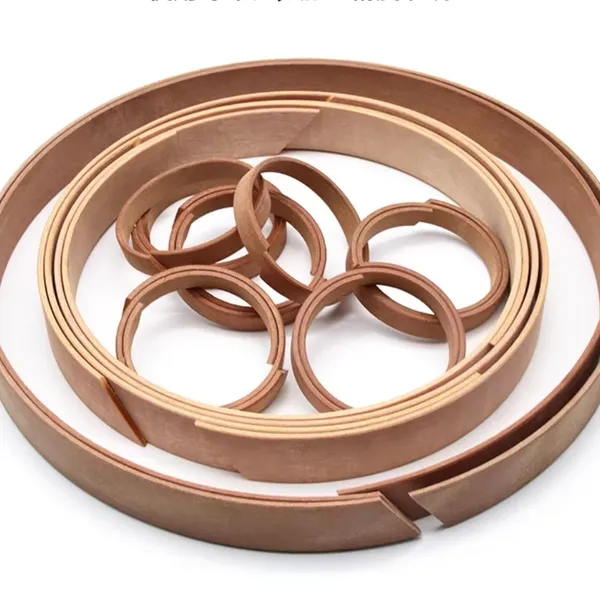
Some workshops use composite or phenolic guide rings, sometimes referred to by local trade names.
Regardless of the material, dimensional accuracy is extremely important.
Key dimensions include:
- Thickness
- Width
- Inside diameter
- Outside diameter
- Installation clearance
If the wear ring thickness is incorrect, the piston may become misaligned.
Severe misalignment can cause the piston to contact and scratch the cylinder barrel.
This is one reason why measuring old components and checking groove dimensions before installation is so important.
3.4 O-Rings and Backup Rings
Hydraulic cylinders also use a variety of smaller static seals, including:
- O-rings
- Backup rings
- Static seals
- Retaining rings
These components are inexpensive, but an incorrect size, material, or installation direction can still cause the entire cylinder repair to fail.
Backup rings are especially important in high-pressure applications because they help prevent O-rings from extruding into clearance gaps.
4.Why You Should Not Replace Only the Main Rod Seal
When a hydraulic cylinder starts leaking, some repair shops replace only the primary rod seal.
This may temporarily stop the leakage, but it may not solve the underlying problem.
For example:
4.1 Worn Guide Bushing
A worn guide bushing allows the piston rod to move sideways.
The new rod seal then experiences uneven pressure and can fail again quickly.
4.2 Damaged Buffer Seal
Without a functioning buffer seal, pressure spikes reach the primary rod seal directly.
This accelerates seal wear.
4.3 Damaged Piston Rod
A scratched or corroded piston rod can continuously damage a new rod seal during operation.
4.4 Internal Piston Leakage
The cylinder may have no visible external leakage but still experience boom drift or weak performance due to piston seal failure.
For this reason, a complete hydraulic cylinder seal kit is often the better repair solution.
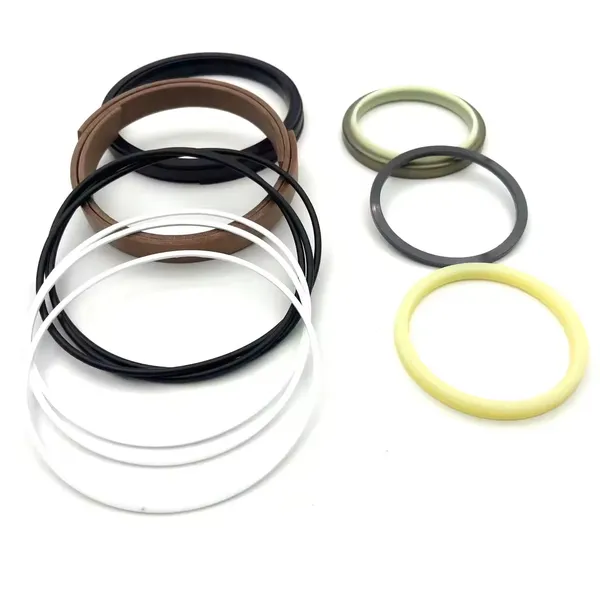
5.What Is Included in excavator Hydraulic Cylinder Seal Kit?
The exact contents depend on the cylinder design and machine model.
A typical excavator cylinder seal kit may include:
| Component | Main Function |
|---|---|
| Rod Seal | Prevents external oil leakage |
| Buffer Seal | Reduces pressure spikes |
| Wiper Seal | Prevents contamination from entering |
| Piston Seal | Prevents internal oil bypass |
| Wear Ring | Supports and guides the piston |
| Guide Ring | Reduces metal contact and side loading |
| O-Ring | Provides static sealing |
| Backup Ring | Prevents O-ring extrusion |
Some seal kits may also contain:
- Retaining rings
- Buffer rings
- Piston support rings
- Cylinder head static seals
- Additional guide components
Because different cylinders may use different seal arrangements, seal kits should always be matched carefully.
6. How to Choose the Correct Excavator Cylinder Seal Kit
6.1 Confirm the Cylinder Part Number
An excavator model may use several different versions of the same cylinder.
For example, simply knowing the machine is a:
- CAT 320
- Komatsu PC200
- SANY SY215
may not always be enough.
The most useful information includes:
- Machine model
- Machine serial number
- Cylinder part number
- Cylinder position
You should also identify whether you need a:
- Boom cylinder seal kit
- Arm cylinder seal kit
- Bucket cylinder seal kit
These cylinders normally use different seal kits.
6.2 Do Not Judge by Appearance Alone
Two seals may look almost identical but still be incompatible.
Always compare:
- Inside diameter
- Outside diameter
- Width
- Height
- Groove dimensions
- Material
- Hardness
- Lip design
This is especially important for multi-piece piston seals.
6.3 Check the Mechanical Condition of the Cylinder
Before installing a new seal kit, inspect the cylinder itself.
Check the Piston Rod
Look for:
- Chrome peeling
- Rust
- Scratches
- Pitting
- Bending
- Check the Cylinder Barrel
Inspect for:
- Scoring
- Internal wear
- Corrosion
- Surface damage
- Check the Guide Bushing
Inspect for:
- Excessive wear
- Loose clearance
- Damaged coating
If these mechanical problems are not repaired, even a high-quality new seal kit may fail prematurely.
7.Important Seal Installation Tips
Correct seals can still fail if they are installed incorrectly.
During installation:
- Clean all seal grooves thoroughly
- Remove sharp edges and burrs
- Do not damage sealing lips with sharp tools
- Confirm seal installation direction
- Lubricate seals with clean hydraulic oil
- Avoid overstretching O-rings
- Prevent seals from twisting
- Check wear ring end clearance
- Confirm all grooves are free from contamination
For open-type wear rings or guide rings, follow the original design specification for the joint angle and end gap.
A diagonal cut is commonly used in some applications because it can improve load distribution and reduce direct leakage paths compared with a straight cut.
8.Common Signs of Hydraulic Cylinder Seal Failure
The following symptoms may indicate a seal-related problem.
8.1 External Oil Leakage
Oil appears around the piston rod or cylinder head.
8.2 Boom or Arm Drift
The boom, arm, or bucket slowly drops after the control lever is released.
8.3 Weak Cylinder Force
The cylinder cannot hold or lift the expected load.
8.4 Slow Cylinder Movement
Internal leakage reduces effective hydraulic flow and cylinder efficiency.
8.5 High Hydraulic Oil Temperature
Severe internal leakage converts hydraulic energy into heat.
However, it is important to remember:
Boom drift or weak cylinder performance is not always caused by cylinder seals.
Other possible causes include:
- Main control valve leakage
- Load-holding valve failure
- Relief valve problems
- Hydraulic pump wear
Pressure testing and cylinder leakage testing may be required to identify the actual fault.
9.External Leakage vs. Internal Leakage
Understanding the difference can help simplify diagnosis.
9.1 External Leakage Usually Points to
- Rod seal
- Wiper seal
- Cylinder head seals
- Damaged piston rod
9.2 Internal Leakage Usually Points to
- Piston seal
- Worn cylinder barrel
- Damaged piston
- Excessive internal clearance
If the piston rod is dry but the boom slowly drops under load, internal leakage should be considered.
If oil is visibly leaking around the piston rod, the rod sealing system should be inspected first.
10.Why Seal Kit Quality Matters
The cost of a seal kit is usually small compared with the labor required to remove, rebuild, and reinstall a hydraulic cylinder.
A low-quality seal that fails prematurely can result in:
- Additional machine downtime
- Repeated labor costs
- Hydraulic oil loss
- Cylinder damage
- Contamination of the hydraulic system
For this reason, seal quality should be evaluated based on:
- Material quality
- Dimensional accuracy
- Heat resistance
- Pressure resistance
- Wear resistance
- Compatibility with hydraulic oil
- Correct application
Choosing the correct seal kit can reduce repeat repairs and improve long-term cylinder reliability.
11.Conclusion
Every seal inside an excavator hydraulic cylinder has a specific function.
It is incorrect to assume that:
“As long as the main rod seal is good, the cylinder will not leak.”
A reliable cylinder sealing system depends on several components working together:
Rod Seal + Buffer Seal + Wiper Seal + Piston Seal + Wear Ring + Guide Ring + O-Rings
When rebuilding a hydraulic cylinder, do not inspect only the seals.
You should also check:
- Piston rod condition
- Cylinder barrel condition
- Piston condition
- Guide bushing wear
- Seal groove dimensions
- Hydraulic oil contamination
Correct seal selection, correct dimensions, proper materials, and proper installation are all essential for long service life.
When ordering an excavator hydraulic cylinder seal kit, it is best to provide the:
Machine Model + Cylinder Position + Cylinder Part Number
This information can greatly reduce the risk of ordering the wrong seal kit.
FAQ
1.What is included in an excavator hydraulic cylinder seal kit?
A typical excavator hydraulic cylinder seal kit may include rod seals, buffer seals, wiper seals, piston seals, wear rings, guide rings, O-rings, and backup rings. The exact contents depend on the cylinder type and machine model.
2.How do I know if my excavator cylinder seals are bad?
Common signs include oil leaking around the piston rod, boom or arm drift, weak lifting force, slow cylinder movement, and increased hydraulic oil temperature. Internal seal failure may occur even when there is no visible external leak.
3.What is the difference between a rod seal and a piston seal?
A rod seal prevents hydraulic oil from leaking out around the piston rod, while a piston seal prevents hydraulic oil from bypassing internally from one side of the piston to the other.
4.Should I replace the entire cylinder seal kit or only the leaking seal?
In most cases, replacing the complete seal kit is a better repair approach, especially on older cylinders. Other seals, wear rings, and guide components may already be worn even if only one seal is visibly leaking.
5.How do I choose the correct excavator hydraulic cylinder seal kit?
The best way is to confirm the machine model, machine serial number, cylinder position, and cylinder part number. Do not rely on appearance alone, because similar-looking seals can have different dimensions, materials, and groove requirements.