


Seals are essential components in Caterpillar machines. From excavators and wheel loaders to bulldozers, motor graders, backhoe loaders, skid steer loaders, dump trucks, and mining equipment, seals help control hydraulic pressure, prevent oil leakage, block dust and mud, and protect moving parts from wear.
Caterpillar machines often work in demanding environments such as construction sites, quarries, mining areas, demolition jobs, road projects, agriculture, forestry, and earthmoving operations. In these conditions, a small seal failure can lead to hydraulic oil leaks, cylinder drift, reduced machine power, overheating, contamination, and unplanned downtime.
This guide explains the main application of seals in Caterpillar machines, including hydraulic cylinder seals, O-rings, oil seals, mechanical face seals, wipers, wear rings, backup rings, and complete seal kits.
If you are looking for replacement sealing solutions, FASeals supplies hydraulic seals, seal kits, O-rings, oil seals, mechanical face seals, and custom machined seals for heavy equipment and industrial applications.
Hydraulic Seals:
https://www.faseals.com/hydraulic-seals/
Seal Kits:
https://www.faseals.com/seal-kits/
O-Rings:
https://www.faseals.com/o-rings/
Oil Seals:
https://www.faseals.com/oil-seals/
Mechanical Face Seals:
https://www.faseals.com/mechanical-face-seals/
Machined Seals:
https://www.faseals.com/machined-seals/
Why Seals Matter in Caterpillar Equipment
Caterpillar machines rely heavily on hydraulic, transmission, drivetrain, engine, and undercarriage systems. Each system needs proper sealing to keep fluid inside, keep contamination outside, and maintain reliable operation.
A good sealing system helps:
- Prevent hydraulic oil leakage
- Maintain stable system pressure
- Protect cylinders from dust, mud, and water
- Reduce internal leakage and cylinder drift
- Protect bearings, shafts, and rotating parts
- Improve machine efficiency
- Reduce repair frequency
- Extend component service life
- Lower downtime and maintenance cost
When seals fail, the machine may still move for a short time, but performance usually becomes weaker. A leaking boom cylinder, drifting bucket cylinder, contaminated final drive, or damaged oil seal can quickly lead to expensive repairs if not handled early.
Main Types of Seals Used in Caterpillar Machines
Different Caterpillar systems require different seal types. A hydraulic cylinder seal is different from a final drive face seal, and an O-ring used in a valve block is different from a shaft oil seal used in a rotating component.
Common seal types used in Caterpillar machines include:
Rod seals
Piston seals
Wiper seals / dust seals
Buffer seals
Wear rings / guide rings
Backup rings
O-rings
Oil seals
Mechanical face seals
Gaskets
Custom machined seals
Complete hydraulic cylinder seal kits
FASeals provides a wide range of sealing products for hydraulic systems, construction equipment, earthmoving machines, agricultural equipment, and industrial machinery.
1. Hydraulic Cylinder Seals in Caterpillar Machines
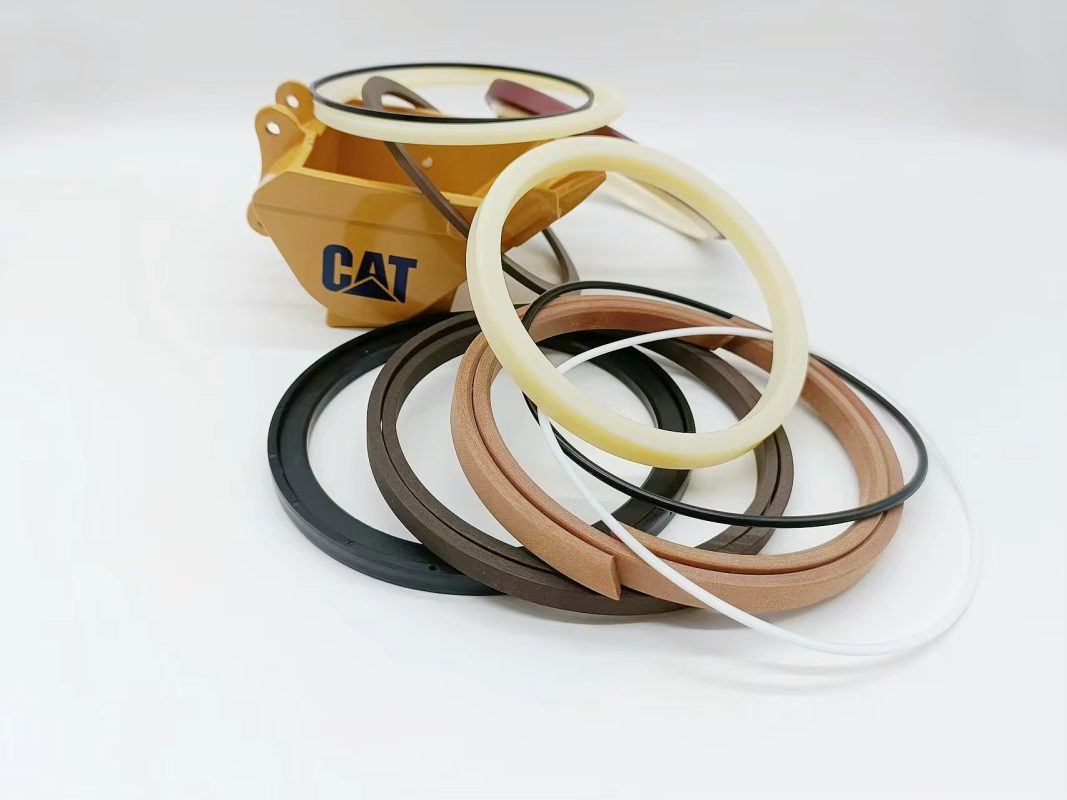
Hydraulic cylinders are one of the most common places where seals are used in Caterpillar equipment. Excavators, loaders, dozers, backhoes, graders, skid steers, and dump trucks all use hydraulic cylinders to create pushing, lifting, tilting, steering, or digging movement.
A Caterpillar hydraulic cylinder usually uses several sealing components, including rod seals, piston seals, wipers, buffer seals, O-rings, backup rings, and wear rings.
FASeals offers hydraulic cylinder components and seals</a> for aftermarket repair and maintenance applications.
Rod Seals
Rod seals are installed in the cylinder gland and seal against the moving chrome rod. Their main function is to stop hydraulic oil from leaking out of the cylinder.
In Caterpillar machines, rod seals are commonly used in:
- Excavator boom cylinders
- Excavator arm cylinders
- Excavator bucket cylinders
- Loader lift cylinders
- Loader tilt cylinders
- Dozer blade cylinders
- Backhoe stabilizer cylinders
- Motor grader steering and blade cylinders
- Dump truck hoist cylinders
When a rod seal fails, oil may appear around the rod or cylinder head. If the machine continues working, dirt can stick to the oil film and damage the rod surface.
Piston Seals
Piston seals are installed on the piston inside the cylinder barrel. Their job is to separate pressure chambers and allow hydraulic pressure to move the cylinder.
In Caterpillar equipment, piston seal failure often causes internal leakage. The cylinder may drift, lose force, or move slowly even when there is no obvious external oil leak.
Common signs of piston seal failure include:
- Boom slowly lowering under load
- Bucket cylinder drifting
- Loader lift arms dropping
- Weak blade movement
- Slow cylinder response
- Hydraulic oil overheating
Wiper Seals
Wiper seals, also called dust seals, are installed at the outer side of the gland. They wipe mud, dust, water, and debris from the rod before it retracts into the cylinder.
For Caterpillar excavators, loaders, and dozers working in mud, sand, gravel, or demolition sites, wiper seals are very important. A damaged wiper can allow contamination to enter the cylinder and damage the rod seal, rod surface, and hydraulic oil.
Wear Rings and Guide Rings
Wear rings guide the piston and rod, helping prevent metal-to-metal contact inside the cylinder. They are especially important in heavy-duty Caterpillar machines because cylinders often work under side load, shock load, and high pressure.
Worn wear rings can cause:
- Uneven seal wear
- Rod misalignment
- Barrel scoring
- Jerky cylinder movement
- Repeated seal failure
Backup Rings
Backup rings support O-rings and other seals under pressure. They help prevent extrusion when hydraulic pressure is high or when clearance gaps are large.
In Caterpillar hydraulic systems, backup rings are often used in cylinders, valve blocks, pumps, and high-pressure connections.
2. Seal Kits for Caterpillar Hydraulic Cylinder Repair
When repairing a Caterpillar hydraulic cylinder, using a complete seal kit is often more reliable than replacing only one damaged seal. A complete seal kit usually includes the main sealing components required for one cylinder position.
Depending on the cylinder design, a Caterpillar cylinder seal kit may include:
- Rod seal
- Piston seal
- Wiper seal
- Buffer seal
- O-rings
- Backup rings
- Wear rings
- Static seals
- Special profile seals
FASeals supplies replacement seal kits for hydraulic cylinder repair, including Caterpillar-related seal kit products such as:
Seal Kits:
https://www.faseals.com/seal-kits/
486-1406 Hydraulic Cylinder Seal Kit for Caterpillar:
https://www.faseals.com/product/486-1406-hydraulic-cylinder-seal-kit/
371-2718 Hydraulic Cylinder Seal Kit for Caterpillar 216B:
https://www.faseals.com/product/371-2718-seal-kit-for-caterpillar-216b/
286-0113 Hydraulic Cylinder Seal Kit for Caterpillar:
https://www.faseals.com/product/286-0113-cylinder-seal-kit-for-caterpillar/
521-2974 Seal Kits for Caterpillar Loader:
https://www.faseals.com/product/521-2974-seal-kits-for-caterpillar-loader/
518-7949 Seal Kit for Caterpillar Loader:
https://www.faseals.com/product/518-7949-seal-kit-for-caterpillar-loader/
Before ordering, always confirm the machine model, cylinder position, cylinder part number, old seal kit number, and seal dimensions.
3. O-Rings in Caterpillar Hydraulic and Engine Systems
O-rings are used in many Caterpillar machine systems. They are simple in shape but very important for preventing leakage between fixed parts.
In Caterpillar machines, O-rings may be used in:
- Hydraulic valve blocks
- Hydraulic pumps
- Hydraulic motors
- Cylinder glands
- Cylinder pistons
- Hose fittings
- Control valves
- Fuel system parts
- Cooling system connections
- Engine oil passages
- Transmission components
- Final drive assemblies
O-rings can be made from different materials such as NBR, FKM, EPDM, silicone, PTFE, and other compounds. The correct material depends on oil type, temperature, pressure, and chemical exposure.
O-Rings:
https://www.faseals.com/o-rings/
4. Oil Seals in Caterpillar Rotating Components
Oil seals are commonly used around rotating shafts. Their main job is to keep lubricant inside and block dust, water, and debris from entering the component.
In Caterpillar machines, oil seals may be found in:
- Engines
- Transmissions
- Hydraulic pumps
- Travel motors
- Swing motors
- Final drives
- Axles
- Gearboxes
- Fan drives
- PTO systems
- Idler and roller assemblies
A failed oil seal can cause oil leakage, bearing damage, overheating, and contamination. If the shaft surface is scratched or worn, simply replacing the oil seal may not solve the problem.
Oil Seals:
https://www.faseals.com/oil-seals/
5. Mechanical Face Seals in Caterpillar Undercarriage and Final Drive Systems
Mechanical face seals are used in heavy-duty rotating applications where the component must operate in mud, sand, water, dust, and impact conditions.
In Caterpillar machines, mechanical face seals are commonly used in:
- Final drives
- Track rollers
- Carrier rollers
- Idlers
- Travel motors
- Mining equipment
- Heavy-duty drivetrain systems
Mechanical face seals help protect lubricated components from harsh external contamination. They are especially important for tracked machines such as excavators, bulldozers, track loaders, and mining equipment.
Mechanical Face Seals:
https://www.faseals.com/mechanical-face-seals/
6. Seals in Caterpillar Excavators
Caterpillar excavators use seals throughout the hydraulic system. The boom, arm, bucket, swing, travel, pilot, and control systems all depend on reliable sealing.
Common seal applications in Caterpillar excavators include:
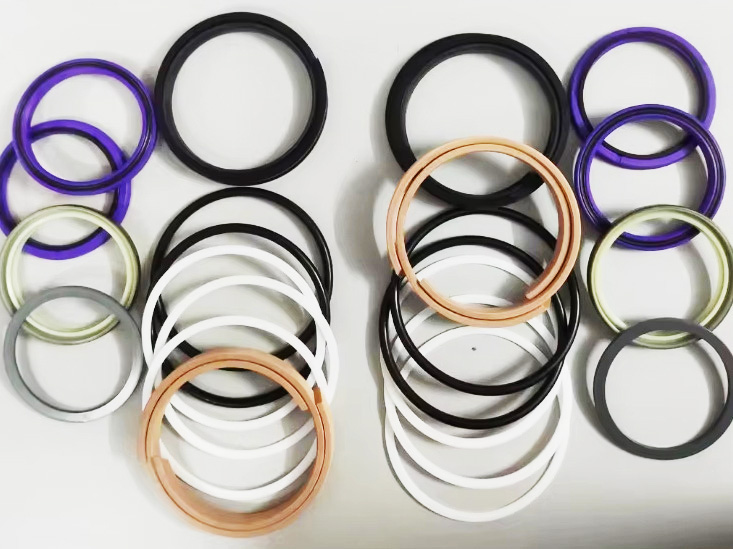
- Boom cylinder seal kits
- Arm cylinder seal kits
- Bucket cylinder seal kits
- Blade cylinder seal kits
- Center joint seal kits
- Main pump seals
- Swing motor seals
- Travel motor seals
- Final drive seals
- Hydraulic valve O-rings
- Track roller face seals
A leaking excavator cylinder can reduce digging force and increase hydraulic oil consumption. A failed wiper seal can allow dirt to enter the cylinder and damage the rod seal.
Hydraulic Seals:
https://www.faseals.com/hydraulic-seals/
7. Seals in Caterpillar Wheel Loaders
Wheel loaders use hydraulic cylinders for lift, tilt, steering, and attachment control. These cylinders often work under heavy load, shock, dust, and vibration.
Common seal applications in Caterpillar wheel loaders include:
- Lift cylinder seals
- Tilt cylinder seals
- Steering cylinder seals
- Hydraulic pump seals
- Transmission oil seals
- Axle seals
- Final drive seals
- Loader attachment cylinder seals
Seal failure in a loader may cause bucket drift, weak lifting power, oil leaks around the cylinder rod, or unstable steering movement.
521-2974 Seal Kits for Caterpillar Loader:
https://www.faseals.com/product/521-2974-seal-kits-for-caterpillar-loader/
518-7949 Seal Kit for Caterpillar Loader:
https://www.faseals.com/product/518-7949-seal-kit-for-caterpillar-loader/
8. Seals in Caterpillar Bulldozers
Caterpillar bulldozers operate in severe ground conditions, including soil, mud, rock, sand, and mining areas. The sealing system must resist contamination and pressure changes.
Common seal applications in Caterpillar dozers include:
- Blade lift cylinder seals
- Blade tilt cylinder seals
- Ripper cylinder seals
- Steering clutch seals
- Transmission seals
- Final drive seals
- Track roller face seals
- Idler seals
- Hydraulic pump seals
Dozers often experience impact and vibration, so seal material and correct installation are important. Wipers, rod seals, wear rings, and backup rings should be inspected carefully during cylinder rebuilds.
9. Seals in Caterpillar Backhoe Loaders and Skid Steer Loaders
Backhoe loaders and skid steer loaders use compact but hard-working hydraulic systems. Cylinders are used for digging, lifting, tilting, stabilizing, steering, and attachment operation.
Common seal applications include:
- Boom cylinder seals
- Dipper cylinder seals
- Bucket cylinder seals
- Stabilizer cylinder seals
- Loader lift cylinder seals
- Loader tilt cylinder seals
- Steering cylinder seals
- Auxiliary hydraulic seals
- Hydraulic quick coupler seals
Because these machines often work in tight spaces, construction yards, farms, and rental fleets, seal failure can quickly interrupt daily work.
371-2718 Hydraulic Cylinder Seal Kit for Caterpillar 216B:
https://www.faseals.com/product/371-2718-seal-kit-for-caterpillar-216b/
10. Seals in Caterpillar Mining and Heavy-Duty Machines
Mining machines, haul trucks, large loaders, shovels, and heavy dozers require sealing products that can handle high load, long working hours, dust, heat, vibration, and contamination.
Common sealing applications include:
- Large hydraulic cylinder seals
- Hoist cylinder seal kits
- Steering cylinder seals
- Suspension cylinder seals
- Final drive seals
- Face seals
- Pump seals
- High-pressure O-rings
- Custom machined seals
For large or non-standard sealing requirements, FASeals can support machined seals based on dimensions, old samples, drawings, or working conditions.
Machined Seals:
https://www.faseals.com/machined-seals/
Common Signs of Seal Failure in Caterpillar Machines
| Symptom | Possible Seal Problem | Suggested Check |
|---|---|---|
| Oil leaking around cylinder rod | Rod seal or wiper failure | Inspect rod surface and gland seals |
| Cylinder drifting under load | Piston seal bypass | Check internal leakage |
| Dirt entering cylinder | Wiper seal damage | Inspect wiper and rod chrome |
| Hydraulic oil level drops | External leakage | Check cylinders, pumps, hoses, and fittings |
| Weak hydraulic movement | Internal leakage or pressure loss | Inspect piston seals and control valves |
| Overheating hydraulic oil | Internal leakage or restriction | Check seals, pumps, and valves |
| Oil leaking from rotating shaft | Oil seal failure | Inspect shaft surface and bearing play |
| Final drive contamination | Face seal failure | Inspect mechanical face seal surfaces |
| Repeated seal failure | Wrong size, material, or damaged groove | Recheck dimensions and cylinder condition |
Do not replace seals only by appearance. Always inspect the rod, barrel, gland, piston, groove, shaft surface, and mating parts before installing new seals.
How to Choose Seals for Caterpillar Machines
To select the correct seal or seal kit, the following information is helpful:
- Caterpillar machine model
- Machine serial number
- Cylinder position
- Cylinder part number
- Seal kit part number
- Old seal photos
- Rod diameter
- Bore diameter
- Groove width and depth
- Working pressure
- Oil type
- Temperature range
- Operating environment
- Quantity required
For Caterpillar hydraulic cylinders, the cylinder position is especially important. A boom cylinder seal kit may be different from an arm cylinder seal kit, bucket cylinder seal kit, or steering cylinder seal kit.
If the part number is not available, FASeals can help identify the seal by dimensions, photos, or samples.
Seal Material Selection for Caterpillar Applications
Different Caterpillar systems require different sealing materials. Choosing the wrong material can cause swelling, hardening, extrusion, cracking, or early leakage.
Common seal materials include:
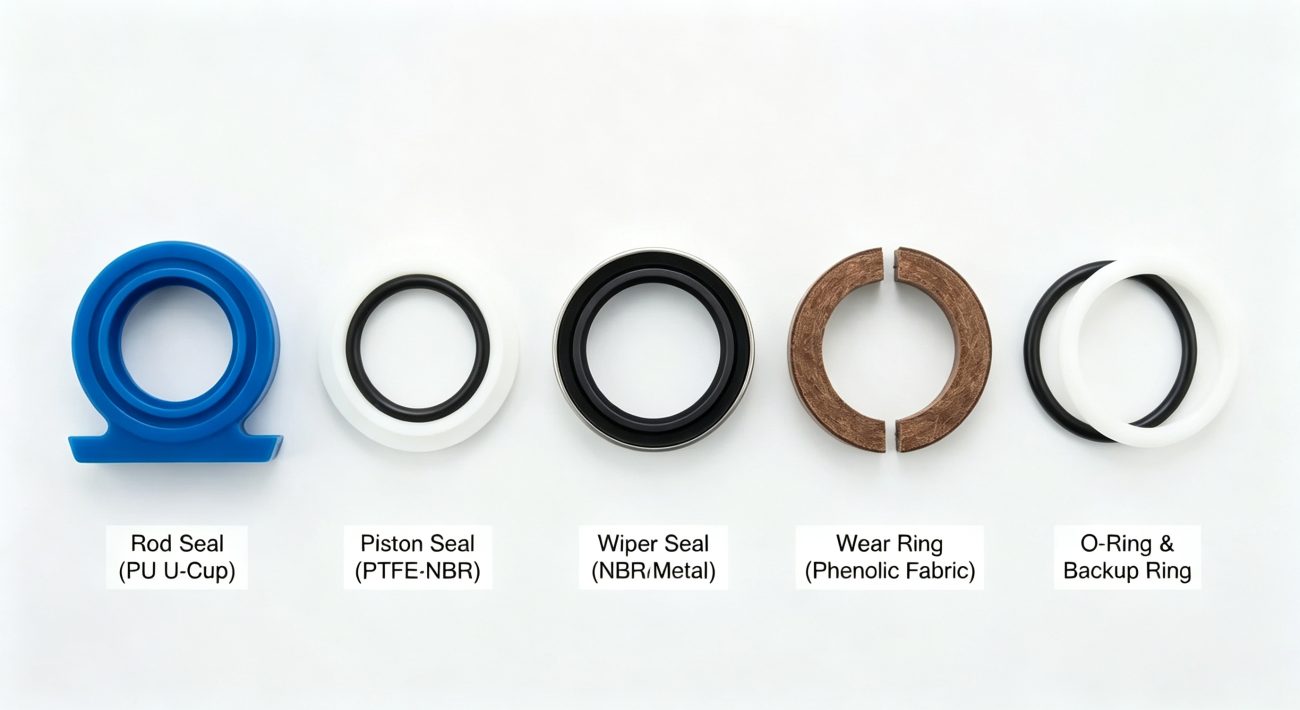
NBR
NBR is commonly used for oil-resistant O-rings, static seals, and general hydraulic applications. It is suitable for many petroleum-based oils.
Polyurethane
Polyurethane is widely used for hydraulic rod seals, piston seals, wipers, and heavy-duty cylinder seals. It offers good wear resistance and is suitable for mobile equipment.
FKM
FKM is used where heat, chemical resistance, and oil resistance are important. It is suitable for higher-temperature or more demanding applications.
PTFE
PTFE is used for low-friction, high-pressure, and special sealing applications. It is often used in piston seals, backup rings, and custom seal designs.
EPDM
EPDM is suitable for water-based fluids and weather-resistant applications, but it is usually not recommended for petroleum-based oil systems.
Sealing Materials:
https://www.faseals.com/sealing-materials/
Standard Seal Kits vs. Custom Sealing Solutions
Standard seal kits are suitable when the Caterpillar machine model, cylinder position, and part number are known. They are convenient for common repairs and routine maintenance.
Custom sealing solutions may be required when:
- The cylinder has been repaired or modified
- The original seal kit is unavailable
- The groove size is non-standard
- The machine is older or discontinued
- The rod or barrel size has changed
- The working pressure is unusually high
- Standard seals fail repeatedly
- Special material resistance is required
Custom Machined Seals:
https://www.faseals.com/machined-seals/
Maintenance Tips for Caterpillar Machine Seals
Proper maintenance can help extend seal life and reduce downtime.
Recommended practices include:
- Keep hydraulic oil clean.
- Replace filters on schedule.
- Inspect cylinder rods for scratches and corrosion.
- Clean mud and debris around cylinder rods.
- Do not ignore small leaks.
- Replace damaged wipers immediately.
- Check wear rings during cylinder rebuilds.
- Avoid using sharp tools when removing old seals.
- Lubricate new seals before installation.
- Confirm seal direction before assembly.
- Test the cylinder at low pressure after repair.
- Recheck for leakage under normal working load.
A new seal cannot perform well if the rod is scratched, the barrel is scored, the groove is damaged, or the wrong material is used.
Why Choose FASeals for Caterpillar Machine Seals?
FASeals supplies sealing products for hydraulic equipment, construction machinery, industrial systems, repair shops, and parts distributors. Our product range includes hydraulic seals, seal kits, O-rings, oil seals, mechanical face seals, machined seals, custom rubber parts, and sealing materials.
FASeals can help with:
- Hydraulic cylinder seal kits
- Excavator seal kits
- Loader cylinder seal kits
- Dozer cylinder seals
- Backhoe loader seal kits
- Skid steer loader seal kits
- O-rings and backup rings
- Final drive face seals
- Oil seals
- Custom machined seals
- Seal identification by sample or dimensions
FASeals is not an authorized dealer, agent, or affiliate of Caterpillar Inc. All replacement seals and seal kits are supplied as aftermarket parts unless otherwise stated.
Conclusion
Seals are used throughout Caterpillar machines, from hydraulic cylinders and pumps to final drives, transmissions, engines, undercarriage components, and rotating shafts. They may be small parts, but they directly affect pressure control, oil retention, contamination protection, machine power, and equipment reliability.
For Caterpillar excavators, loaders, dozers, backhoe loaders, skid steers, graders, dump trucks, and mining equipment, the right sealing solution can reduce leaks, prevent downtime, and extend component life.
FASeals provides hydraulic seals, seal kits, O-rings, oil seals, mechanical face seals, machined seals, and custom sealing solutions for heavy equipment applications. To find the correct seal for your Caterpillar machine, send your part number, machine model, old seal photos, or dimensions to FASeals.