


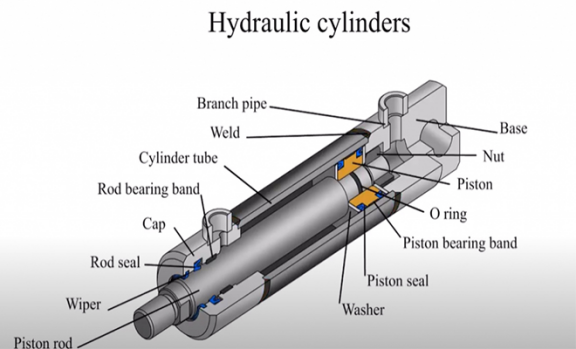
Oil seals are a common term for sealing components, often used in bearings or hydraulic cylinders of various machines. Simply put, they are seals for lubricating oil. Their function is to isolate oil from the external environment, sealing the oil internally and preventing dust from entering externally. They are divided into static seals and dynamic seals.
Static seals
The oil seal sealing interface is a narrow ring band with a width of 0.1-0.2mm. Under the action of preload (usually a spring), there is generally an average radial contact pressure of about 1N/mm2 between the oil seal and the shaft. When the lubricating oil pressure is lower than this pressure value, the oil seal prevents it from leaking to the outside.
Dynamic seals
During normal operation, oil enters the narrow band where the oil seal contacts the shaft through the action of the pump. When the oil enters this contact surface, a hydrodynamic pressure balance is achieved. Now, the oil seal is operating while maintaining a sealing state; this operating state is the lubrication state.
Early oil seal materials were generally leather; soft, elastic, oil-resistant, and widely used. Now the oil seal material is mainly various rubbers. Such as: NBR、ACM、PU、 SILICONE (VMQ / PVMQ), FKM and PTFE,etc…
Related posts


Volvo EC210 Hydraulic Cylinder Seal Kit: 7 Essential Tips
The Volvo EC210 series is a medium-sized crawler excavator widely used in earthmoving, road construction, foundation excavation, and bu...

Komatsu PC2000-8 Repair Kits: A Complete Guide for Backhoe and Loading Shovel Excavators
The Komatsu PC2000-8 is a large mining hydraulic excavator widely used in open-pit mines, quarries, large-scale earthmoving projects, a...

Furukawa Breaker Diaphragm: Structure, Function, Selection and Maintenance Guide
The Furukawa breaker diaphragm is installed inside the accumulator chamber. Its main function is to separate hydraulic oil from nitroge...